
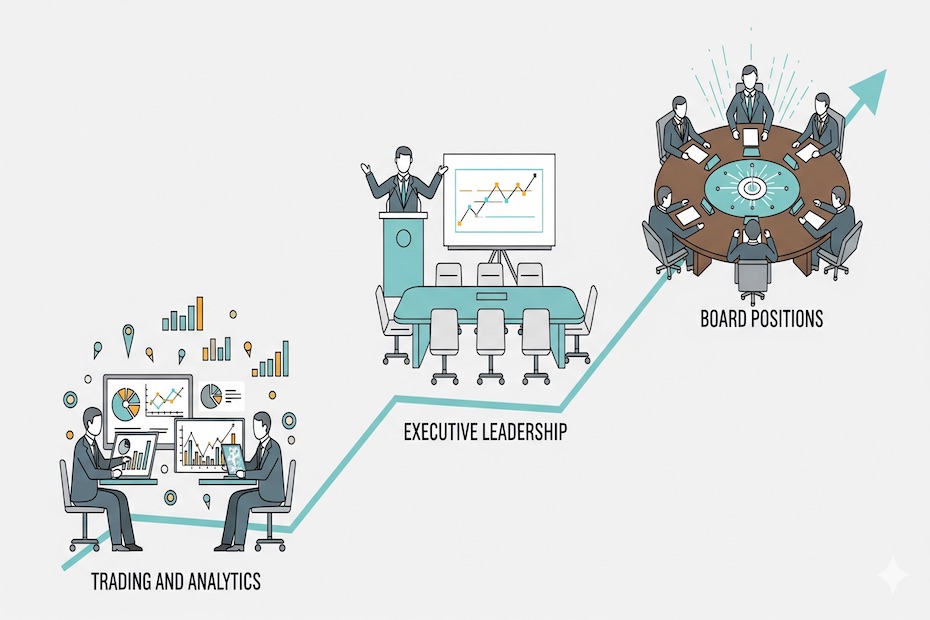
You move from bond futures to boardrooms by translating market judgment, data fluency, and execution discipline into corporate strategy, P&L ownership, and ultimately enterprise leadership. That path is shorter when you target growth industries and deliver measurable business outcomes at each step.
This article gives you a practical cross-industry career timeline. You’ll see which trading skills transfer into strategy and operations, where sector growth creates opportunities, and how milestones like P&L ownership accelerate your move toward the C-suite and board service.
What does a cross-industry career timeline from bond futures to boardrooms look like?
The typical sequence is markets, analytics/strategy, business unit leadership, enterprise management, and board service. Each stage expands your accountability and influence.
Early years in bond futures or trading roles sharpen your ability to make rapid decisions under uncertainty. That sets you apart in corporate environments that value speed, precision, and analytical rigor. Your next step usually lands in roles such as FP&A, corporate strategy, or product analytics—functions that convert numbers into decisions. Over time, you advance into general management, then enterprise leadership.
On average, S&P 500 CEOs today are around 58–59 years old, with departing CEO tenure near nine years. Those numbers give you a practical horizon for career planning while you map the steps from technical execution to enterprise leadership.
Which trading skills transfer best to strategy, product, and operations?
The strongest assets are your decision quality under pressure, your ability to structure uncertainty, and your communication of complex data clearly. Those skills are highly portable.
Recruiters consistently rate problem-solving, communication, and strategic thinking as the top capabilities in global MBA surveys. As a former trader, you already have those traits—only the context shifts. In corporate roles, probabilistic reasoning becomes pricing optimization, market analysis, or scenario planning.
When you frame your experience in those terms, you show hiring managers that your trading expertise is not niche but directly relevant to the growth, cost, and customer decisions they manage daily.
Do you need an MBA to pivot across industries?
An MBA is valuable but not mandatory. It accelerates access to general-management tracks and provides networking leverage, but skills-first hiring is becoming a powerful equalizer.
Recent recruiter surveys confirm strong confidence in MBA graduates. At the same time, LinkedIn data shows skills-first hiring can expand applicant pools more than eightfold for technical roles. This shift means your proven outcomes—growth initiatives, product launches, or cost reductions—carry equal or greater weight than a degree if you showcase them effectively.
Key execution moves
- Translate market results into customer, revenue, and margin outcomes.
- Build artifacts: demand forecasts, pricing models, or dashboards with clear ROI.
- Collect references from cross-functional leaders.
- Use action verbs tied to scope and scale.
- Time your moves in sync with hiring and budget cycles.
How do you make the first leap from markets to corporate roles?
Your fastest entry point is through adjacent seats where your analytical strength is obvious. FP&A, treasury, corporate development, and product analytics are logical starting points.
Internal transfers often move quicker than external pivots because your firm already trusts your judgment. Still, external opportunities are strong if you demonstrate shipped projects and clear business outcomes. Job-switching communities reinforce this: candidates who quantify value and network into strategy or product teams gain traction faster.
Side projects—pricing pilots, market-entry analyses, or forecasting dashboards—often provide the proof of capability you need to be taken seriously outside of pure trading.
Which industries are adding roles that value your market experience?
U.S. Bureau of Labor Statistics data projects the strongest 2024–2034 job growth in healthcare (+8.4%), professional and technical services (+7.5%), and information (+6.5%). These industries absorb leaders with quantitative strength and execution discipline.
Within them, management analysts (median pay $101,190) and financial managers (median pay $161,700, with 15% growth through 2034) are standout roles that bridge markets experience with enterprise operations. They give you scope to shape decisions at scale and move onto the GM or CFO track.
These industries also favor leaders who can adapt judgment to digital platforms, regulatory shifts, and rapid customer adoption cycles—an excellent match for your trading background.
How long to reach the C-suite—and what milestones matter?
The timeline averages 12–20 years from early markets roles to C-suite positions. The variation depends on how quickly you secure milestones.
The key gates are:
- Owning a model or tool that senior leadership uses for decision-making.
- Owning a product or P&L.
- Leading multi-function teams across regions.
- Delivering a turnaround or scaling mandate.
CEO tenures are shortening, with boards rotating leadership faster. That favors leaders who can demonstrate repeatable playbooks across industries. If you show you can take lessons from markets into corporate expansion or transformation, your timeline compresses significantly.
Which credentials actually change outcomes (CFA, FRM, PMP, data)?
Credentials signal specialization, but they matter most when paired with shipped work. A CFA or FRM validates market and risk expertise, PMP proves delivery discipline, and SQL or Python certifications confirm your data ability.
The mistake is to stop at the credential. Employers and recruiters increasingly screen for evidence of execution. A pricing dashboard you built, a risk framework you implemented, or a productivity lift you achieved with automation outweighs the letters on your CV.
Pair any certification with portfolio proof, and you’ll position yourself as a practitioner who can deliver—not just a candidate who passed exams.
How do you tell your story so recruiters read you as “operator,” not “trader”?
The key is to lead with business outcomes and frame your work in operator language. Replace trading jargon with plain business terms: revenue, margin, adoption, churn, or customer lifetime value.
One effective format is: state the business problem, show the decision you made, quantify the outcome, and link it to organizational goals. Example: “Applied risk analysis from markets to build a dynamic pricing model, increasing gross margin by X points.”
Recruiters and hiring managers respond best to candidates who align their story with business KPIs and stakeholder benefits. Short, direct statements tied to measurable results outperform technical jargon every time.
Career Roadmap: From Markets to Boardrooms in 4 Steps
- Markets → analytics and strategy
- Strategy → P&L ownership
- P&L → multi-region leadership
- C-suite → board service
- Focus on growth sectors and measurable outcomes
In Conclusion
Your career timeline from bond futures to boardrooms depends on how well you translate trading skills into corporate execution, target sectors with strong growth, and hit milestones that expand your scope. Anchor your story in measurable business outcomes, pursue credentials strategically, and align with industries where analytical leaders are in demand. With consistent execution, you accelerate your move from market floors to the boardroom table.
For more career roadmaps, leadership insights, and strategy resources, explore my Pinterest boards.