
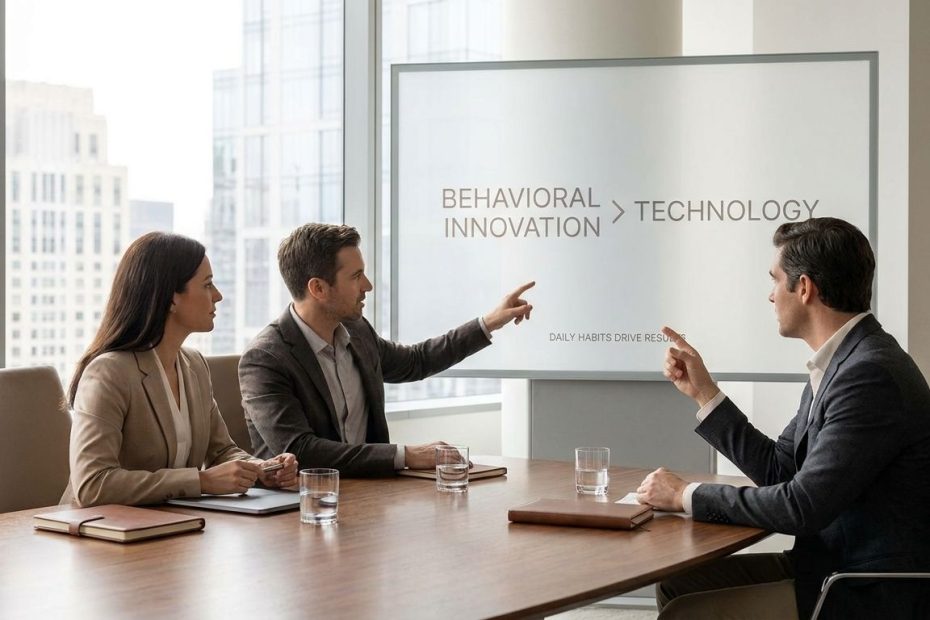
You can buy software, license artificial intelligence, and deploy automation across your company, yet still miss the result you wanted. The gain usually comes when you change what people actually do every day, how they decide, what they repeat, what they ignore, and what the organization rewards.
If you want better adoption, stronger execution, and results that hold up under pressure, you need to treat behavior as the real innovation asset. This article shows you why behavior creates more value than technology alone, where companies get this wrong, and how you can design habits, defaults, feedback, and trust into the way work gets done.
Why Do People Say The Most Valuable Innovation Isn’t Tech, But Behavior?
You hear this argument more often now because leaders have watched too many expensive rollouts underperform. A new platform goes live, the interface looks polished, training gets scheduled, dashboards appear, and executive updates sound promising. Then adoption stalls, workarounds return, managers stop reinforcing the new process, and the old habits quietly win.
That pattern is not a technology failure in the strict sense. It is a behavior failure. The tool created capability, but capability did not convert into action. If you want innovation to produce revenue, lower risk, better service, faster decisions, or stronger compliance, you need people to act differently at the moment the work actually happens.
Transformation research keeps pointing to the same truth. Large change efforts fail at a stubborn rate, and digital transformation tends to be even tougher when leaders assume software deployment equals operational change. What separates the few companies that get real returns is not the presence of technology alone. It is the presence of operating habits, management routines, reinforcement systems, and clear behavior shifts that make the new way of working stick.
You can think of technology as an amplifier. It speeds up whatever behavior already exists. If your teams already share information well, make decisions with discipline, and follow through consistently, technology helps. If your teams avoid accountability, resist documentation, and treat new workflows as optional, technology scales that mess too. That is why behavior often carries more value than the tool itself.
From an executive standpoint, this matters for one simple reason: behavior compounds. A license fee gives you access. A repeated action creates output. A repeated action across teams creates a system. A system sustained over time becomes an advantage that competitors cannot copy as easily as a feature set.
What Is Behavioral Innovation?
Behavioral innovation means redesigning how people act so better outcomes become more likely, more consistent, and easier to sustain. The innovation is not always a new product, device, or platform. Often, it is a new default, a clearer prompt, a smarter feedback loop, a better sequence of actions, or a stronger social norm inside the workflow.
That distinction matters more than most strategy decks admit. Product innovation gives you a new thing. Behavioral innovation gives you a new pattern. If the pattern improves decision quality, compliance, service quality, safety, customer retention, or execution speed, you have created value in a form that reaches the daily operating layer of the business.
Health systems, public institutions, and policy groups have treated this as a serious discipline for years. Behavioral science applies psychology, social science, decision research, and systems design to shape real actions in real settings. The reason that matters to you is practical, not academic. It shows that behavior can be engineered, tested, measured, and improved with the same seriousness you bring to product design or process improvement.
You see this whenever a small change in how choices are presented alters participation rates, completion rates, or compliance. You also see it when a team begins following one shared operating rhythm and output rises without adding more headcount. The visible artifact may look modest. The effect can be large because human behavior sits between intention and result.
If you lead a company, a function, or a transformation effort, behavioral innovation gives you a better question to ask. Stop asking only, “What tool did we launch?” Start asking, “What behavior did we make easier, faster, safer, and more rewarding?” That question gets you much closer to economic value.
Why Does Technology So Often Fail Without Behavior Change?
Technology fails in practice when it adds steps, creates uncertainty, or asks people to absorb short-term pain for delayed benefit. Most employees do not resist change because they dislike progress. They resist work that feels slower, riskier, less clear, or disconnected from what their manager actually values.
Take customer relationship management systems, sales enablement tools, knowledge bases, internal automation platforms, or even artificial intelligence assistants. On paper, each can improve productivity. In day-to-day use, many become one more place to log information, one more screen to update, one more process to remember. If the immediate friction feels greater than the immediate reward, your rollout has a behavioral design flaw.
This is where many leaders misdiagnose the issue. They frame the problem as weak user discipline or poor training. Sometimes training is part of it, but usually the deeper issue is incentive design and workflow reality. If a seller can close business without keeping the system current, the system will not stay current. If a nurse has to take extra steps to comply during a rushed shift, compliance slips. If a manager does not review the new data in weekly meetings, people stop entering it accurately.
You cannot solve that by repeating the benefits of the platform. You solve it by reducing friction, embedding prompts into the flow of work, making the right action easier than the wrong one, and aligning management behavior with the change. Employees watch what gets measured, what gets praised, what gets corrected, and what gets ignored. Those signals shape adoption more than launch messaging ever will.
That is why the most valuable innovation is often invisible at first glance. It is the redesign of choice, effort, timing, and reinforcement around the technology. When behavior changes, the technology starts delivering what the business case promised. Without that change, the business case remains a slide.
How Do Small Behavioral Shifts Create Outsized Results?
Small behavioral shifts matter because many outcomes are cumulative. A tiny improvement repeated hundreds or thousands of times becomes material. When that repeated action sits inside a high-frequency process, even modest gains can produce major effects in cost control, safety, conversion, retention, speed, or quality.
Defaults are one of the strongest examples. When the preferred action is preselected, participation can rise sharply without forcing anyone’s hand. The reason is simple: people often accept the path of least resistance when the decision feels routine, low-risk, or easy to postpone. Changing the default changes the action that happens when attention is low.
Healthcare offers another strong lesson. Studies on hand hygiene and soap use show that reminders, prompts, visible cues, and performance feedback can improve compliance. No breakthrough machine is required for that gain. The lift comes from shaping behavior at the exact point where the action should occur, then reinforcing it with timely signals and accountability.
You can apply the same logic in commercial settings. Auto-fill key fields in a system and completion rates rise. Put the decision prompt where the approval actually happens and response time drops. Show a team its performance against peers and adherence improves. Reduce the number of clicks needed to document work and data quality improves. In each case, the lift does not come from a dramatic invention. It comes from behavioral design.
This is where many executives miss hidden value. They search for breakthrough technology while leaving obvious behavior friction in place. Yet removing one recurring point of drag can unlock more return than buying another platform. You should treat repeated behaviors as leverage points. The higher the frequency, the more valuable the redesign.
What Makes Behavioral Change Stick Inside Organizations?
Behavior sticks when the new action is easy enough to repeat, visible enough to notice, reinforced enough to matter, and connected enough to daily work that it does not feel optional. Announcements do not create stickiness. Repetition does. Systems do. Manager behavior does.
One reason habits hold is that people do not make each decision from scratch. They rely on cues, routines, shortcuts, and social proof. If your organization wants a new behavior to last, you need to build it into those existing human tendencies rather than fight them. Put the cue where the work starts. Put the new action in the natural sequence. Put feedback close to the moment of performance.
Rewards matter too, but not only formal rewards. Speed, convenience, reduced confusion, peer approval, manager attention, and lower error risk all function as rewards. If your new process saves time and reduces uncertainty, adoption gains force. If your new process adds friction and exposes people to blame, avoidance becomes rational.
Trust also plays a major role. Teams change faster when they believe the system is fair, the metrics are credible, and management will not use every new tool as a surveillance weapon. Research on innovation and defensive routines shows that trust can reduce protective behavior that blocks learning and experimentation. If people feel exposed, they hide. If they feel safe enough to engage, they adjust and improve.
You should also pay attention to managerial cadence. Weekly reviews, one-on-ones, team standups, quality checks, and post-project debriefs are behavior engines. If the new behavior appears inside those rhythms, it becomes real. If it sits outside them, it becomes extra work. Leaders who understand this stop treating change management as a communication exercise and start treating it as operating design.
Why Are Habits, Incentives, And Norms More Defensible Than Tools?
A competitor can buy the same software you use. They can hire the same consultants, license similar models, and deploy similar automation. What they cannot easily copy is a workforce that consistently acts in ways that produce better outcomes. That is where behavioral innovation becomes strategically valuable.
Habits are sticky because they live in the rhythm of the organization. Incentives are sticky because they shape what people pursue under pressure. Norms are sticky because they influence conduct even when nobody is watching closely. When all three align, performance becomes less dependent on heroic effort and more dependent on repeatable execution.
This is one reason many companies with strong tools still underperform simpler operators. Their stack looks modern, but their habits are weak. Meetings do not drive decisions. Data entry is incomplete. Handovers are sloppy. Priorities shift every week. Managers tolerate workarounds. The result is operational drag hidden beneath polished systems.
On the other side, a company with fewer tools but stronger behavior often moves faster and executes better. Teams know what good looks like. People document the right things without constant reminders. Managers inspect the process and coach against clear standards. That consistency creates reliability, which is one of the most valuable business assets you can build.
If you want a more defensible company, do not focus only on proprietary technology. Focus on proprietary behavior, the routines, decision patterns, and standards that produce output with less friction and less variance. Those are much harder to replicate because they depend on culture translated into action, not slogans.
How Can You Design Behavioral Innovation Into Daily Work?
You start by identifying the specific behavior that produces the result you want. That sounds obvious, yet many change efforts remain vague. Leaders say they want collaboration, customer focus, data-driven decisions, or stronger adoption. Those phrases are too broad to manage. You need an observable action attached to a moment in the workflow.
If you want better customer retention, define the exact behavior. Maybe account managers must log risk signals within twenty-four hours and trigger a recovery playbook. If you want stronger sales visibility, define the exact behavior. Maybe every opportunity above a certain threshold must include next-step dates, stakeholder mapping, and documented decision criteria before forecast review. Precision matters because behavior cannot improve when the target is fuzzy.
Once you define the action, reduce friction around it. Remove steps. Auto-populate fields. Place the prompt in the right screen. Tighten the sequence so the desired action happens before a task can be closed or approved. Use defaults where appropriate. Give people a reason to comply that they feel immediately, not six months later in a strategy memo.
Then reinforce the behavior with visibility and management follow-through. Review the behavior in team meetings. Show completion rates and quality scores. Recognize teams that execute well. Correct gaps quickly. If the behavior matters, your operating rhythm should prove it matters. Silence tells employees more than launch decks ever will.
You also need to test what works. Behavioral innovation is not about guessing what people should do and hoping they comply. Run pilots. Compare uptake across teams. Adjust prompts, timing, and incentives. Measure whether the behavior improves and whether the business outcome follows. Treat behavior design with the same rigor you bring to product experiments or process improvement efforts.
How Should You Measure Behavioral Innovation?
If you only measure outcomes at the end of the chain, you will miss the operational signals that tell you whether the change is taking hold. Behavioral innovation needs leading indicators, not just lagging metrics. You need evidence that the right actions are happening repeatedly, at the right quality level, in the right parts of the workflow.
Start with adoption quality, not vanity usage. Logins alone tell you very little. Measure workflow completion, field accuracy, response times, handoff quality, repeat use over time, and drop-off points. A user opening the system is not the same as a user completing the new operating pattern correctly.
Track habit strength as well. Look at whether people sustain the new action across weeks, whether managers reinforce it consistently, and whether performance holds under busy conditions. The strongest proof of behavior change is not a launch-week spike. It is repeatability when attention shifts elsewhere.
You should also measure social spread. Which teams adopt faster, and why? Who helps peers use the new process correctly? Which managers drive adherence without constant escalation? Behavior often moves through social channels before it appears in company-wide averages. If you identify those channels early, you can accelerate uptake.
Then connect those leading indicators to outcomes that matter commercially or operationally. Tie cleaner customer relationship management data to forecast accuracy, conversion, or sales cycle length. Tie hygiene compliance to infection-related measures. Tie workflow adherence to cycle time, defect rates, or service quality. Once you show the chain from behavior to business result, you shift the conversation from opinion to operating evidence.
What Can Leaders Do When Adoption Stalls?
When adoption stalls, resist the urge to blame attitude first. Start by examining the design of the work. Ask where the friction sits, where the reward is delayed, where the process conflicts with real incentives, and where managers are sending mixed signals. Most stalled rollouts have a behavioral explanation you can fix.
Look closely at the immediate experience of the user. Is the desired action faster than the old one, or slower? Does the system reduce rework, or create it? Is the employee clear on why the action matters right now, not in abstract terms? If you cannot answer those questions from direct observation, you are operating too far from the work.
Then examine leadership behavior. Are managers using the new system in reviews, decisions, and coaching conversations? Or are they allowing side channels and exceptions that undermine the process? Employees notice contradictions quickly. If the formal process says one thing and leadership behavior says another, leadership behavior wins every time.
Resetting adoption often means simplifying the workflow, tightening accountability, and making the benefit visible faster. It can also mean changing who owns the process. In many organizations, no one truly owns the behavioral outcome, only the technology deployment. That split creates a gap where accountability disappears. Assign ownership for the action, not just the tool.
You should also communicate with precision. Do not say “use the platform better.” Say what good behavior looks like, when it must happen, how it will be reviewed, and what support is available. Vague change messages invite selective interpretation. Clear operating standards reduce drift.
What Does This Mean For Your Innovation Strategy?
If you want your innovation strategy to produce durable value, you need to rank behavior alongside product, platform, and process. That does not mean technology loses importance. It means technology stops being treated as the entire answer. The return comes from the combination of capability and conduct.
This changes how you allocate time and resources. You spend less effort celebrating deployment and more effort engineering adoption. You invest in workflow design, reinforcement systems, manager capability, performance feedback, and trust. You ask whether the new tool changes behavior at the point of execution, not whether the roadmap looks impressive.
It also changes what you consider innovative. A smarter default can be innovative. A better meeting rhythm can be innovative. A cleaner decision handoff can be innovative. A feedback loop that raises compliance can be innovative. If the change creates measurable performance gain by improving human action, it belongs in your innovation portfolio.
For many organizations, this becomes the missing bridge between strategy and execution. Leaders often know what they want to achieve. Teams often have capable tools. The breakdown happens in the middle, inside the daily choices people make under deadlines, distractions, and competing incentives. Behavioral innovation targets that middle layer directly.
If you build your strategy this way, you stop chasing novelty for its own sake. You begin building systems that make the right action easier, more likely, and more repeatable. That is where value grows. That is where transformation starts to hold.
Why Is Behavioral Innovation More Valuable Than Technology Alone?
- It turns capability into repeatable action.
- It improves adoption, compliance, and execution.
- It compounds through habits, incentives, and norms.
- It is harder for competitors to copy than tools.
- It connects daily work to measurable business results.
Turn Behavior Into Your Real Competitive Edge
If you want innovation to pay off, stop treating behavior as a soft issue and start treating it as operating infrastructure. The tools you buy matter, but the actions people repeat every day decide whether those tools create revenue, speed, safety, and trust. When you define the right behaviors, remove friction, reinforce the routine, and measure adoption with discipline, your results become more durable and far less dependent on launch enthusiasm. That is the real advantage, not a bigger stack, but a better pattern of execution. If you keep your attention on what people actually do, you will build an organization that captures more value from every piece of technology it touches.
If you want more sharp analysis like this on innovation, execution, and operating performance, visit my social profile and explore the rest of my posts.
References:
- https://www.mckinsey.com/capabilities/people-and-organizational-performance/our-insights/unlocking-success-in-digital-transformations
- https://www.who.int/initiatives/behavioural-sciences
- https://www.researchgate.net/publication/8996952_Medicine_Do_defaults_save_lives
- https://ape.socialcatalystlab.org/papers/apep_1263/v1/paper.pdf
- https://www.sciencedirect.com/science/article/pii/S2590088925000587
- https://business.columbia.edu/insights/brand-talk/power-knowing-your-consumers-habits
- https://link.springer.com/article/10.1186/s13731-020-00143-3
- https://www.sciencedirect.com/science/article/pii/S0196655320309913
- https://www.gartner.com/smarterwithgartner/cios-break-through-culture-barriers-to-enable-digital-transformation
- https://www.reddit.com/r/CRM/comments/1srebto/is_low_crm_adoption_really_a_user_problem_or_a/.