
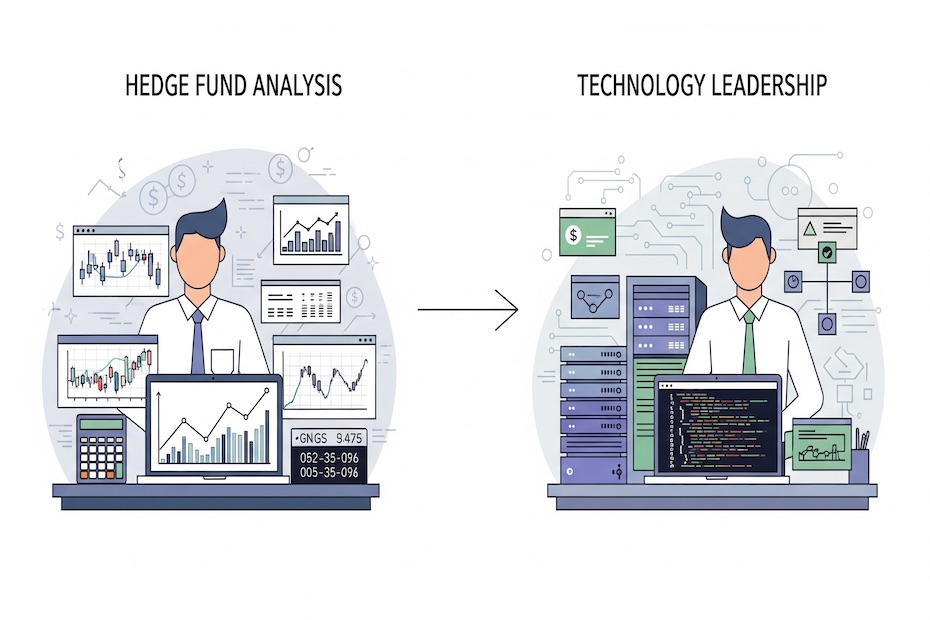
You bridge hedge funds and tech leadership by reframing your financial rigor, risk modeling, and rapid execution into product velocity, automation, and scalable business outcomes. This shift allows you to operate as a cross-sector leader in organizations that prize both capital discipline and technological innovation.
This article maps how successful executives make the transition. You’ll see real career examples, the transferable skills that matter, the industries hiring hybrid leaders, and how to craft your narrative so recruiters and boards read you as an operator who thrives across sectors.
What does leadership look like when transitioning from hedge funds into tech roles?
When you move from hedge funds into technology, your leadership shifts from managing trades to orchestrating products and platforms. The common thread is decision making under pressure, but the outputs differ.
Hedge fund leaders excel at risk assessment, rapid iteration, and quantifying uncertainty. In technology, those same capabilities become roadmap prioritization, automation initiatives, and system reliability. Executives like Ilya Gaysinskiy at Point72 embody this. After starting in financial engineering, he now drives global tech hubs, AI integration, and developer experience for one of the most sophisticated hedge funds. His mandate: reduce friction for engineers so the firm innovates faster.
This illustrates what the shift looks like—less about capturing alpha, more about scaling systems, empowering teams, and aligning tech outcomes with enterprise strategy.
How have peers made this switch successfully?
The career arcs of executives who crossed from finance into technology show you where to focus. Kristin McDonald left hedge fund analysis to become a partner at Eniac Ventures, now leading AI-focused investments across industries like healthcare and law. Her credibility comes from understanding risk and capital deployment, but her edge is translating that into venture bets on next-generation platforms.
Charlie Mitchell at Brevan Howard demonstrates another model. He manages corporate development while also steering trading technology and AI initiatives. His hybrid role requires financial judgment, but his impact is measured in innovation adoption and enterprise growth.
Both examples highlight that the transition succeeds when you reframe yourself as a strategist and builder, not just a risk taker.
Why are hedge funds prioritizing tech leadership today?
The hedge fund sector is now competing on digital capacity as much as on trading acumen. Funds like Point72 and Citadel understand that without automation, AI, and infrastructure modernization, execution speed stalls.
At Point72, Gaysinskiy opened hubs in Poland and India, launched campus recruiting pipelines, and implemented generative AI across development. The message is clear: technology isn’t just an enabler, it’s a competitive weapon.
For you, this means the door is open wider than ever for cross-sector leaders. Hedge funds are hungry for tech-savvy executives who can fuse strategy, product, and capital allocation.
What transferable skills make you valuable across finance and tech?
Your transferable assets fall into four categories: decision quality, quantitative fluency, risk-reward modeling, and stakeholder collaboration. These are the same skills recruiters consistently rank as top priorities for leadership hires.
In practice, your market modeling becomes product pricing and performance analytics. Your risk assessment becomes system reliability and cloud optimization. Your stakeholder management—once about investor updates—becomes cross-functional communication with engineers, product managers, and business leads.
Strengths that travel seamlessly:
- Making high-pressure decisions with incomplete data
- Building quantitative models that forecast performance
- Translating risk-reward tradeoffs into product priorities
- Managing stakeholders with clear, measurable outcomes
This blend ensures that you’re not just switching industries—you’re expanding your impact.
How do you craft your narrative for recruiters and boards?
Your narrative must lead with business outcomes, not technical jargon. Replace hedge fund language with enterprise terms: revenue, adoption, uptime, margin, churn.
When you frame your story, structure it in four steps: problem, decision, outcome, and impact. For example: “Applied risk analysis from trading to build a dynamic pricing model, lifting gross margin by four points and reducing customer churn.”
Boards and hiring executives scan for leaders who can link domain expertise to enterprise results. By anchoring your narrative in measurable business outcomes, you reposition yourself as an operator who scales value, not just a trader who priced risk.
Which industries now demand cross-sector leadership most?
Several industries actively recruit leaders who understand both capital and technology: fintech, AI platforms, digital assets, and quantitative technology firms. Two Sigma offers a clear case study—its leadership transition showed how founders entrusted operational control to executives with both legal and technology fluency.
Beyond finance, venture firms like Eniac are expanding into AI, while hedge funds like Brevan Howard are building dedicated tech working groups. These moves show the increasing demand for executives who bring financial rigor and product execution in the same package.
If you’re looking to move, target firms in fintech, enterprise AI, and data-driven investment management. They reward the exact skill set you bring.
How do successful tech leaders sustain momentum in hybrid roles?
Tech leaders who thrive across sectors share two traits: continuous curiosity and business fluency. Katie Graham Shannon of Heidrick & Struggles emphasizes that top tech executives must be “the most curious person in the room,” translating technical vision into business strategy.
That means you must constantly upgrade your knowledge in areas like cloud economics, generative AI, developer workflows, and cyber resilience. But knowledge alone isn’t enough—you must package it in business terms so your peers in finance, product, and operations understand the tradeoffs.
The discipline you learned in hedge funds—constant research, relentless iteration, clear accountability—becomes your operating advantage when leading hybrid teams in tech-driven firms.
Key Guide to Cross-Sector Leadership
- Bridge hedge fund rigor with tech scalability
- Translate risk models into product velocity metrics
- Target fintech, AI, and digital asset firms
- Present outcomes in business language
- Sustain momentum with continuous curiosity
In Conclusion
You succeed in bridging hedge funds and tech by reframing your analytical discipline into scalable outcomes, targeting firms that prioritize digital innovation, and telling your story in business-first terms. Real examples—from hedge fund CTOs to venture partners—prove that financial acumen and tech leadership are no longer separate paths but a single, accelerated route to executive impact.
For more insights on leadership at the intersection of finance and technology, explore my writing on Medium.