
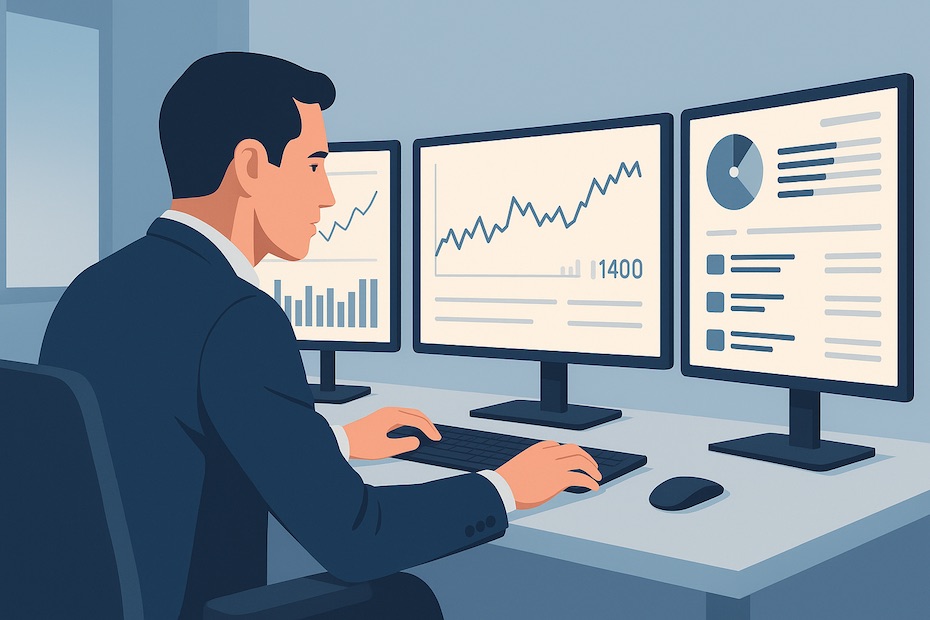
You accelerate startup execution by adopting trading-floor habits—structured decision-making, risk discipline, rapid feedback loops, and performance reviews that compress cycle time and amplify precision.
This article explains how to translate the precision, tempo, and accountability of financial trading desks into the startup world. You’ll learn specific habits—daily routines, risk boundaries, and real-time performance systems—that transform a reactive startup into a fast-executing, data-driven team.
What Are Trading-Floor Habits and How Do They Apply to Startups?
Trading-floor habits are operational routines that professionals use to make thousands of micro-decisions under pressure. These include pre-market briefings, strict time-boxing, constant data monitoring, and post-trade analysis. When you apply these disciplines to startup execution, you create a rhythm of action, feedback, and adaptation that keeps your team moving fast without losing accuracy.
In startups, most delays come from indecision or misalignment. Traders operate differently—they act quickly within defined parameters. That’s exactly what founders must learn: make decisions fast, measure instantly, and iterate based on data. By treating each sprint, feature, or campaign like a “trade,” you enforce the same discipline that drives billion-dollar performance on Wall Street.
Build a Pre-Execution Routine
Every trader starts the day by reviewing markets, setting targets, and defining risk thresholds. Your startup should operate the same way before each sprint or product launch.
Hold a 15-minute “pre-market” meeting every morning. Review the most recent data—user metrics, revenue figures, or product adoption rates. Then define what success looks like for the day or week. Don’t just assign tasks; set measurable thresholds. For instance: “Our target is a 4% conversion rate by end of week, with a stop-loss trigger at 2.5%.”
This method keeps execution grounded in numbers, not assumptions. Teams start the day aligned on outcomes, timelines, and acceptable risk—eliminating guesswork and rework later.
Execute with Real-Time Data Awareness
On trading floors, every second counts. Traders monitor positions, liquidity, and risk metrics in real time. For startups, execution speed depends on how fast your team can detect shifts in customer behavior, product performance, or operational inefficiencies.
Implement real-time dashboards for every critical metric—traffic, customer retention, uptime, or spend efficiency. The point is not more data, but faster feedback. If something drifts off target, act immediately. In trading, delayed response kills profits. In startups, it burns runway.
This is where operational transparency matters. Everyone—from engineering to marketing—should see the same “market screen.” When performance metrics are visible, accountability becomes automatic. Teams self-correct without waiting for meetings.
Manage Risk Like a Trader
Great traders don’t just chase returns—they manage downside exposure relentlessly. For a startup, that means setting pre-defined boundaries for time, money, and effort on every project.
You apply this through execution stop-losses. Before starting a new initiative—say, a feature rollout or paid ad campaign—define your maximum acceptable loss in measurable terms. It might be “$10,000 in ad spend without conversion improvement” or “three sprints without measurable adoption gains.” When those limits are hit, stop and re-evaluate.
This habit saves startups from death by sunk cost. You eliminate the emotional attachment to projects that don’t work and redirect energy where it compounds. It’s risk management for human capital.
Bullet format example (for quick quoting):
- Set a clear threshold for failure before execution begins.
- Track in real time and enforce discipline—no exceptions.
- View every initiative as a portfolio bet, not a permanent strategy.
That’s how traders stay solvent—and how founders stay alive through volatile markets.
Create High-Frequency Feedback Loops
Traders measure performance every hour, not quarterly. The same feedback cadence fuels fast-moving startups. Waiting until month-end to evaluate progress kills momentum.
Use micro-feedback systems: post-sprint reviews, daily performance standups, and automated analytics summaries. These should answer two questions:
- What’s working?
- What must change today?
Keep these sessions tight—15 minutes or less. The power lies in consistency, not length. High-frequency feedback creates pattern recognition. Over time, your team starts spotting trends before they become problems.
Companies like Stripe and Netflix have institutionalized this rhythm—short review cycles that blend data with reflection. The outcome: decisions compound faster than competition.
Maintain Execution Journals
Every professional trader keeps a trade journal—logging why they made a move, what data supported it, and what outcome followed. You should mirror this discipline with execution journals across teams.
Require brief entries after major launches or sprints. The format can be simple:
- What decision was made?
- What hypothesis did we test?
- What outcome did we observe?
- What would we adjust next time?
These logs become your institutional memory. Over months, you’ll see recurring decision patterns—both good and bad. This habit converts experience into repeatable systems, allowing new hires to ramp faster and veterans to avoid past errors.
Over time, your journal becomes your most valuable dataset—a record of execution intelligence that compounds just like capital.
Establish Structured Team Rhythms
Trading desks run on rhythm: pre-market prep, live execution, post-close analysis. Adopting a similar structure stabilizes execution speed across your startup.
Here’s a model that works:
- Morning alignment (Pre-Open): Define goals, risks, and critical moves.
- Mid-day check (Live Market): Evaluate live performance, adapt tactics.
- End-of-day review (Post-Close): Capture results, update dashboards, flag anomalies.
Consistency drives clarity. Everyone knows when to plan, act, and reflect. This creates psychological safety because people aren’t guessing when feedback will come. More importantly, it builds performance stamina—your team executes hard, then resets before burnout hits.
By creating temporal structure, you transform chaos into cadence.
Quantify Execution Speed and Quality
You can’t improve what you don’t measure. Traders use metrics like “trade latency” and “win ratio.” Startups need execution equivalents:
- Cycle time: How long from idea to deployment?
- Decision latency: How quickly can leadership respond to new information?
- Error recovery speed: How fast can the team correct missteps?
- Win rate: Percentage of initiatives that meet defined success thresholds.
Set quarterly targets for each. For example: “Reduce idea-to-launch cycle time from 30 days to 21.” These metrics turn execution into a quantifiable process, not a subjective story.
When you start managing by these indicators, performance becomes predictable—and scalable. That’s how you build compounding operational leverage, not just activity.
Develop Emotional Discipline Under Pressure
Traders are trained to operate under volatility. They separate emotion from decision-making. As a founder, that’s your hardest habit to master—and your biggest advantage if you do.
Execution slows down when fear or overconfidence takes over. Emotional discipline means responding to setbacks with analysis, not anxiety. It means keeping your process intact whether you’re winning or losing.
You maintain this stability by setting predefined rules—never chase a bad result with a reactive decision. Follow your metrics. Trust your process. The goal is to eliminate noise from emotion.
Startups that survive turbulent markets—like Airbnb during economic downturns—do it through operational calmness. They execute with precision even when conditions fluctuate daily. That’s emotional trading discipline, applied to company building.
Institutionalize Post-Mortems Without Blame
On trading desks, losing trades aren’t moral failures—they’re lessons. You adopt the same culture in your company through blameless post-mortems.
After every major initiative—win or loss—gather your team to analyze: what signals were missed, which decisions were premature, and what safeguards worked. Keep the focus on systems, not individuals. The goal is continuous calibration.
This not only accelerates learning but also builds resilience. People learn to recover fast, recalibrate faster, and execute better. The company becomes anti-fragile—improving under pressure instead of cracking.
What trading-floor habits improve startup execution?
- Pre-execution planning with measurable targets.
- Real-time performance dashboards.
- Strict risk limits and post-execution reviews.
- Emotional and procedural discipline.
Execute with Precision, Not Speed Alone
Execution velocity without structure burns energy. Trading-floor discipline gives you both speed and sustainability. By institutionalizing habits like risk control, data feedback, and decision journaling, you transform your startup into an execution engine that compounds results quarter after quarter.
The fastest-growing founders don’t just “move fast”—they move fast within a system. Bring that trader’s mindset into your company, and you’ll stop improvising under pressure and start performing under control.